← All projects 2 May 2025 UAV · Airframe engineering
Rebuilding a capture drone around a full carbon-fibre airframe
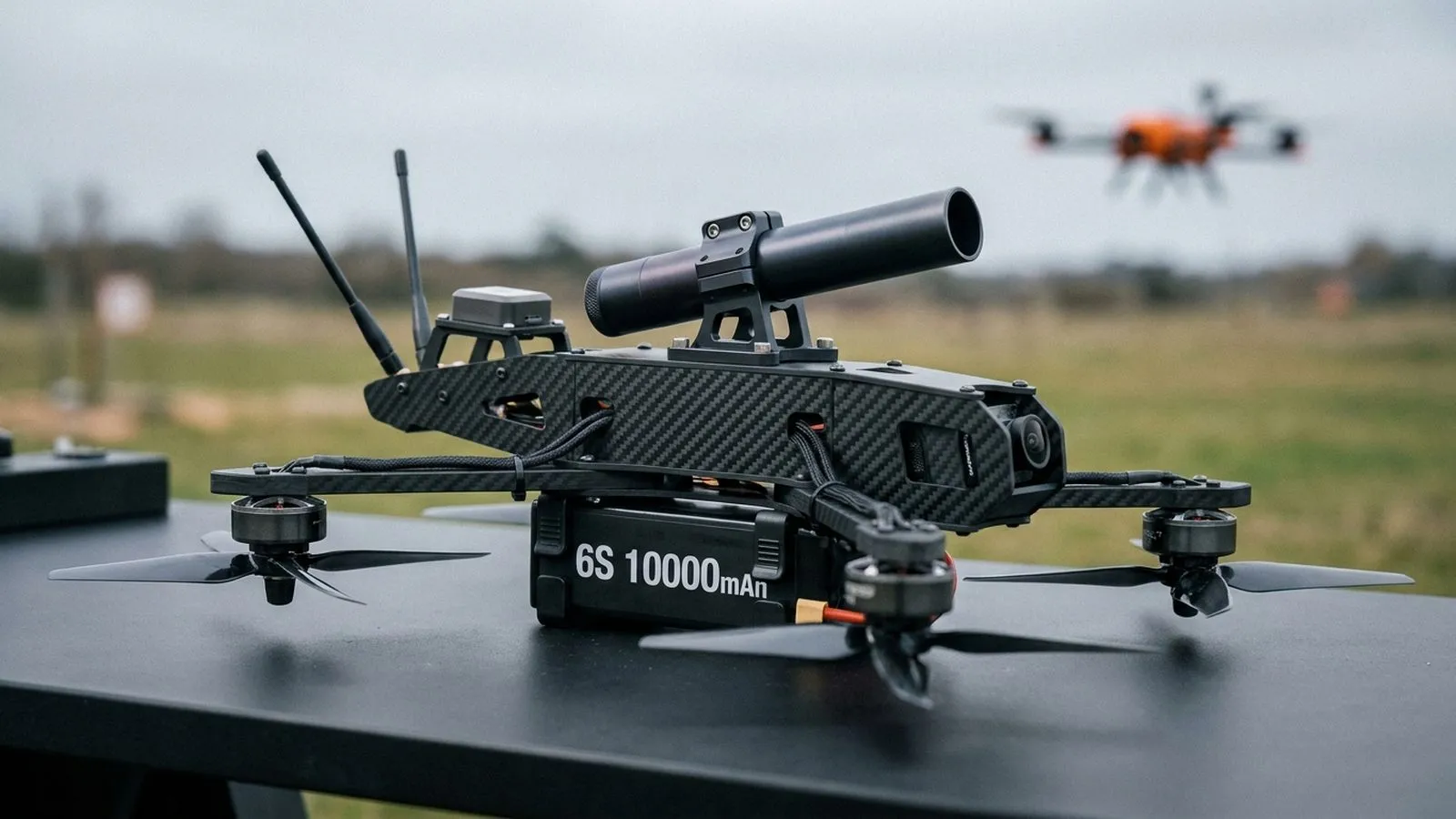
The first phase of this programme delivered a working aerial capture system. Phase two asks a harder question: can the same mission be flown by a lighter, stiffer, better-balanced aircraft — and can we prove it against a real flying target rather than a bench test?
A different aircraft under the same mission
The rebuild starts at the structure. Almost nothing of the original layout survives:
- A new 13-inch all-carbon airframe with a carbon support frame, the propellers relocated to an under-slung configuration and the RTK antenna repositioned to suit.
- The custom aluminium launcher moves to the top of the aircraft on a purpose-made clamp designed and manufactured for the job.
- The 6S 10,000 mAh pack moves underneath, onto a quick-release mount so a flat battery costs seconds rather than minutes between test sorties.
- Centre of gravity and load distribution recalculated and verified — swapping the two heaviest items changes the aircraft’s inertia in every axis.
Retuning everything that moves
A new mass distribution invalidates the old control tune, so flight-control parameters are recalibrated from scratch and the low-level firmware modified to match — including driver and algorithm work for any sensor or peripheral the new layout introduces. The HD video downlink is integrated alongside RC control and the LoRa ground-station link, deliberately keeping compatibility with the ground hardware the customer already owns.
The ground-station software is then re-commissioned against the new aircraft parameters and communication protocol, with interface and workflow improvements built on the existing application rather than a rewrite.
Capture and tracking, reworked
The capture algorithm is re-optimised for the ballistics and dynamics of the new mechanical layout, and target tracking is pushed further on both accuracy and response time. Neither can be tuned honestly without something to fly against — so a 7–10 inch target aircraft, spare batteries and ten sets of launcher consumables were procured as part of the work package.
Proving it in the air
Two of our engineers fly the joint test campaign, one on the target aircraft and one on the ground station. Results are reported as capture success rate and tracking accuracy, and the aircraft is handed over with mechanical drawings for the airframe, clamp and quick-release, the flight-control firmware image and change notes, the updated ground-station build, a full test report and operating and maintenance manuals.
Next project
A mobile inspection platform for hard-to-reach filter banks