← All projects 14 July 2026 UAV · Systems integration
Putting a capture drone on the road: vehicle-mounted nest integration
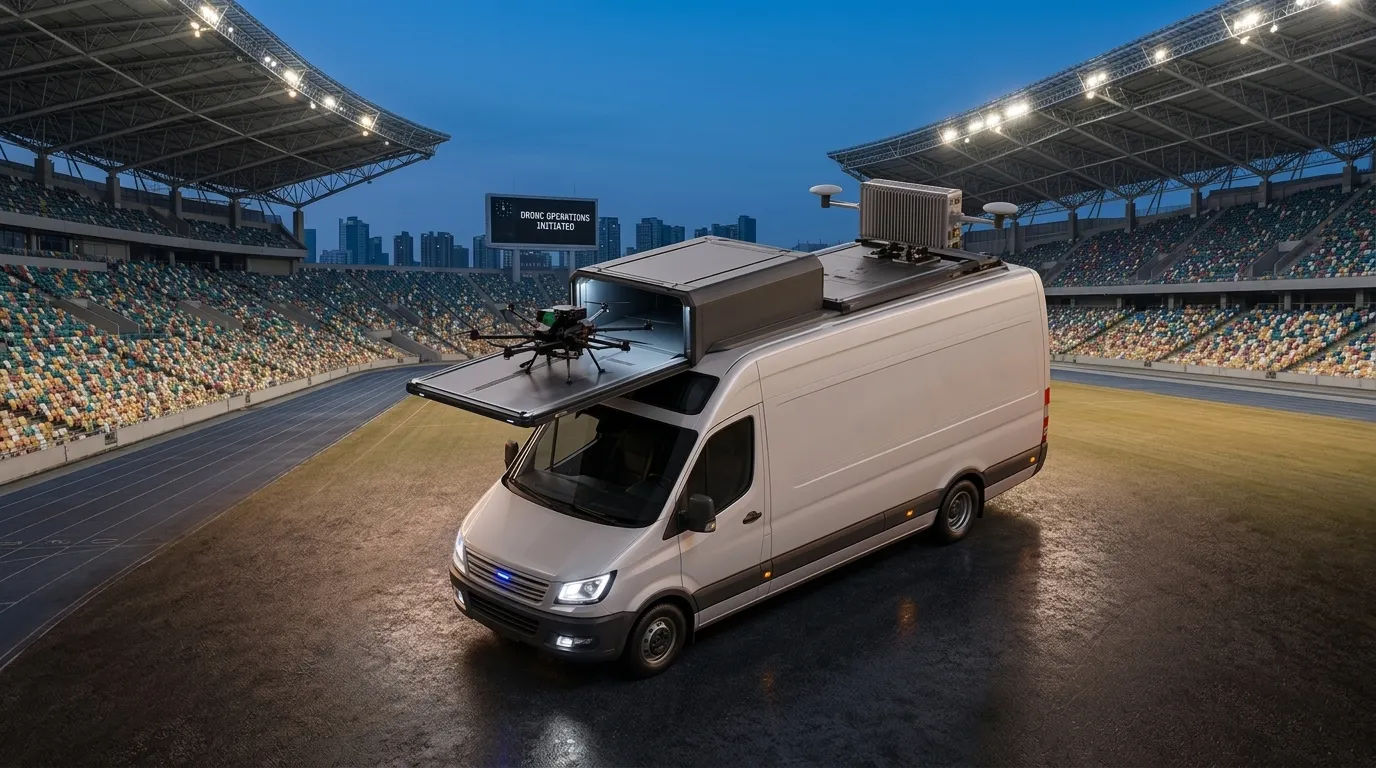
The customer already operates the first-generation capture drone and the ground-station software we built for it. The next requirement is mobility: launch from a nest carried on a vehicle, fly the mission, return and land beside the nest — one prototype, built to be deployed rather than demonstrated.
Three systems, one operator
- The aircraft gains an RTK module — mounting, cable routing and structural adaptation on the hardware side, and firmware integration for the module and for the nest’s communication protocol.
- The ground station gains nest control: hatch operation, status display and start/stop logic, driven through the nest supplier’s open interface.
- A third-party RESTful API exposes hatch state, aircraft position, battery level and RTK fix quality, so a demonstration wall display can read the system without being wired into its internals.
- Engineering drawings define the nest-to-vehicle interface, letting the vehicle fabricator build the mounting frame to a specification rather than to a photograph.
Testing on the ground before testing in the air
Integration and link testing happen at our own facility first: LoRa control and 2.4 GHz video stability, RTK accuracy and reliability, nest and aircraft talking to each other with the operator in the loop. Only then does the system move to the customer’s site for live flights covering the full cycle — launch from the nest, fly the mission, return and land.
Scope discipline is a design decision
Precise autonomous landing back inside the nest was deliberately excluded. Returning and landing nearby met the operational requirement at a fraction of the cost and schedule of closed-loop nest capture — and the interface is left open for it later. Vehicle mounting fabrication and vehicle power remain with the specialists who do that work; the nest carries its own supply.
The handover includes the modified aircraft, the commissioned nest, nest-to-vehicle engineering drawings, the upgraded ground station, API documentation, operating and modification manuals and the acceptance test report — backed by twelve months of warranty and a month of on-site commissioning support.
Next project
Ecological restoration in a hydropower disturbance zone: AI identification with explainable plan recommendation