← All projects 29 July 2026 Robotics · Security & inspection
A robot dog on patrol: one platform doing security rounds and safety inspection
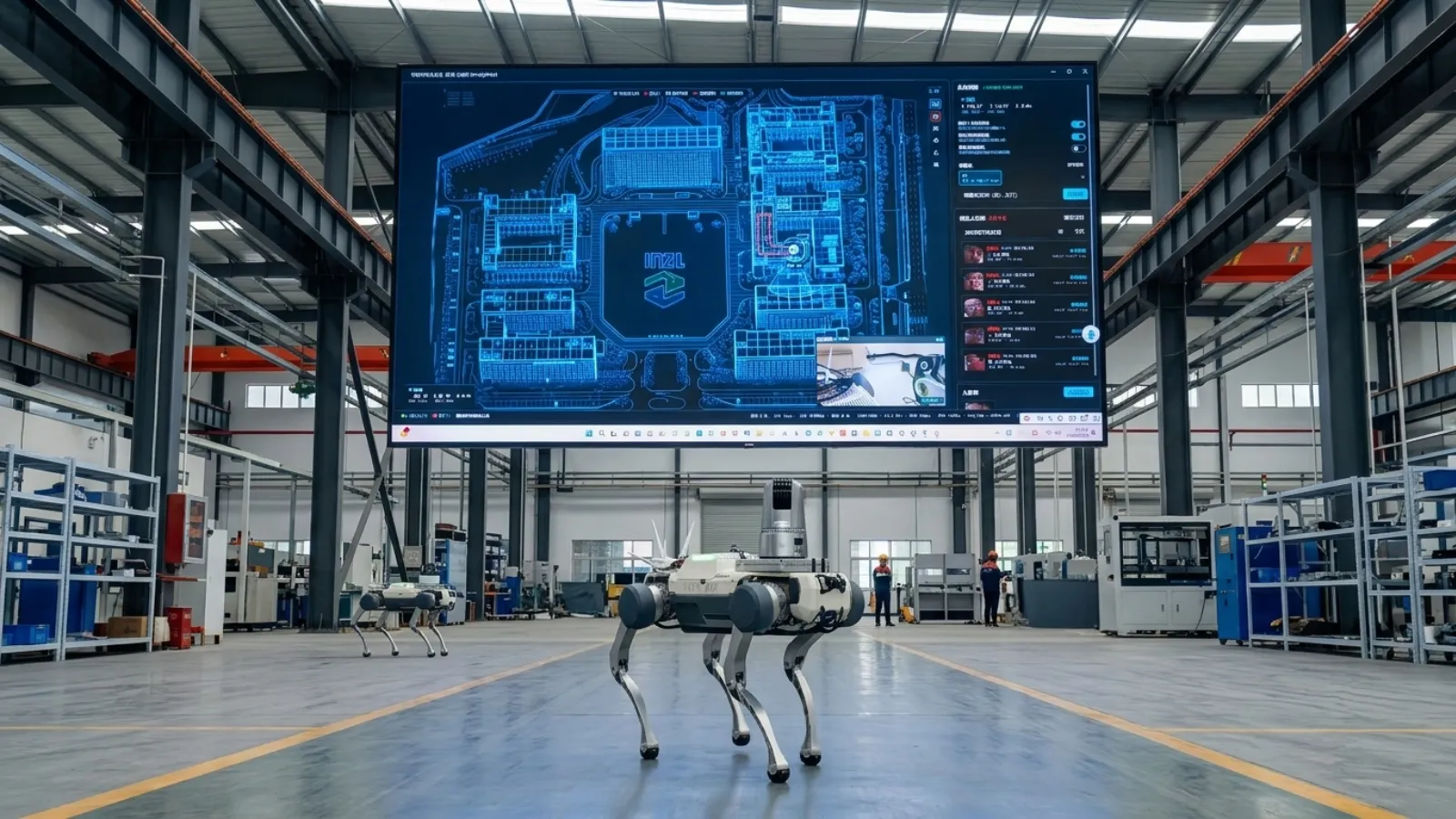
Every factory and industrial park runs patrols. Security walks the perimeter and the quiet buildings after hours; safety walks the plant looking at the things a checklist says to look at. Both jobs are repetitive, both happen at inconvenient hours, and both degrade in exactly the same way — a round walked for the four-hundredth time at three in the morning is not the same round that was walked on day one. A robot is indifferent to that. It walks the identical route, stops at the identical positions, and points the camera at the identical angle, every single time.
Why legs
Industrial sites are not built for wheels. Between a robot and the far end of a plant sit stairs, kerbs, door sills, cable trays, drainage channels, grating and gravel — obstacles a wheeled platform has to route around, if it can get there at all. A quadruped steps over them and keeps going, which means the patrol route can be the route a person would actually walk rather than a compromise negotiated with the floor plan.
The locomotion itself is not ours to reinvent: the platform is a commercially available DEEP Robotics X30. Our work is everything above it — the sensor payload and its mounting, the perception stack, the patrol autonomy, and the operations software the site actually looks at.
Two jobs, one patrol
The payload deck carries a pan-tilt-zoom camera under full software control, and that single sensor serves both missions. For security, the robot distinguishes registered personnel from people it does not recognise. When it picks up someone unrecognised, the gimbal tracks them automatically — keeping the target centred in frame — and zooms in once locked, because a face at 1.1 metres and a face at twenty metres are very different pieces of evidence. With nothing to look at, the camera falls back to sweeping a defined sector. Named preset positions let it snap to the views that matter: the main gate, a loading dock, a particular corner.
For safety, the same fixed route and the same preset camera positions do something a roaming human inspector cannot: they make the record comparable. Because every pass frames the same equipment from the same angle at the same zoom, this week’s image can be put beside last month’s and the difference actually means something — rather than being an artefact of where somebody happened to stand.
What the operator sees
The control screen is a 2.5D model of the site — buildings, the patrol path, camera positions and their field-of-view cones — with registered staff and unrecognised persons plotted onto it live. Every detection is written to a timestamped log with the bearing and approximate range it was seen at, a note of clothing colour, and the exact pan, tilt and zoom the camera held at the time. That last detail is the useful one: an operator reviewing an event hours later can send the camera straight back to the precise view that produced it, instead of hunting for it.
Inference on the robot, not in the cloud
Detection and recognition run on the robot’s own GPU rather than streaming video to a server. In practice that is a 1920 × 1080 feed detected at 640-pixel scale in around 14 milliseconds, sustaining roughly 15 frames per second, with face embeddings cached and reused between frames so the expensive step only runs when it needs to. Two things follow from keeping it local. Site bandwidth stays free for everything else, and — more importantly — the patrol carries on working when the network does not.
The part that is not engineering
Any system that recognises people carries obligations that vary by jurisdiction, and they are not the robot’s to resolve. In Australia, biometric information is sensitive information under the Privacy Act: consent, retention periods, who may access footage and how long a face record survives are policy decisions belonging to the site operator. What we build is the machinery that lets those decisions be enforced and evidenced — a personnel register, a complete audit trail, and retention controls. Where identity is not warranted, the same patrol runs perfectly well as presence-and-absence detection with no recognition at all. That is a deployment choice, and it should be made deliberately rather than by default.
Where it stands
The system is in service, walking factory floors and industrial-park grounds and running both missions off the same platform. The direction from here is less about the robot and more about what it accumulates: a fixed route walked repeatedly builds a consistent visual history of a site, and that history is worth considerably more than any single patrol.
Next project
MineRover — intelligent underground transport