← All projects 3 February 2026 Product engineering · Consumer robotics
From working prototype to pilot production: a companion robot’s second revision
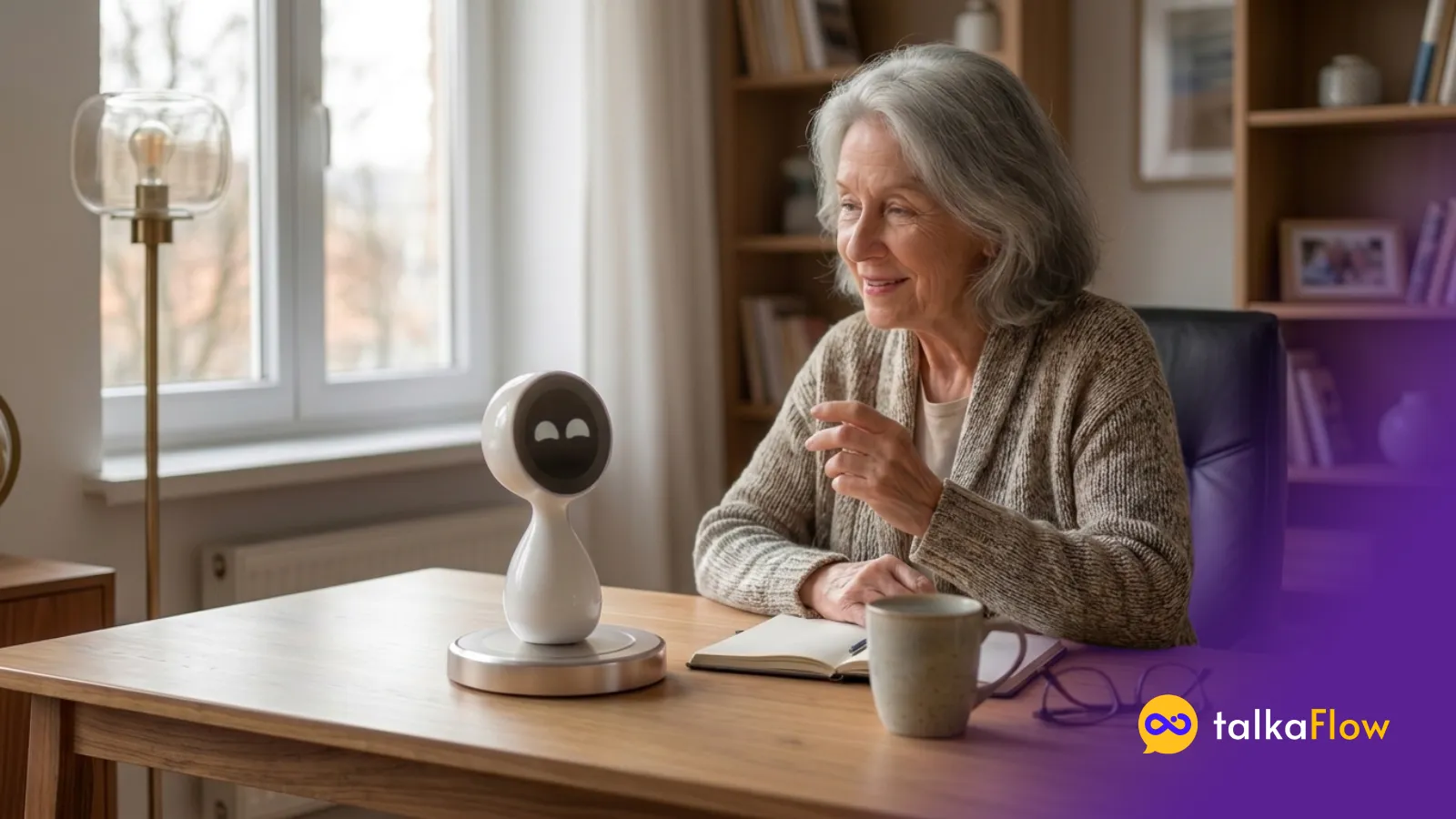
The Alpha prototype worked. It moved its head, held a conversation, showed emotion and exposed interfaces for health monitoring — enough to prove the product to its intended users. What it had not proven was that it could be built repeatedly, by a factory, to a consistent standard. That gap is what this programme closes.
What the prototype was telling us
Prototypes fail informatively. This one flagged four things: not enough power headroom under load, a fragile inter-board link, far-field microphone sensitivity that fell away in a real living room, and connectors that would not survive assembly-line handling, let alone service.
The v2 redesign
- Power architecture rebuilt — a combined charge/discharge boost stage rated beyond 2.1 A with headroom to 3 A, a larger low-impedance cell, full-plane copper pours with dense stitching vias on the connector and base boards, and bulk capacitance at every module supply pin.
- The base-board I²C bus split in two: the host link separated from the local touch, lighting and motor bus, pull-ups moved onto a rail that drops at power-off, and resistor values retuned so the bus can no longer back-feed the system awake.
- Audio reworked around a four-channel ADC that provides a hardware loopback of the speaker output, giving echo cancellation a genuine reference signal instead of an estimate, with the twin-microphone arrangement retained.
- Mechanical and connector reliability — locking FPC sockets that tolerate repeated insertion, test points on every critical net, a single 1.25 mm pitch across every interface, and corrected peripheral polarity.
- A power-gated radar supply, so the sensor is switched off by firmware when the robot is idle rather than drawing current all day.
Firmware, and a clean handover
We take the low-level firmware — battery management, bus communication, audio channel configuration, radar control — and an API document written for the customer’s own application and cloud team. Part of the deliverable is unglamorous but essential: every debugging shortcut taken during development is reverted to its production setting before handover, so what ships is what was tested.
Ready to build
Five to ten engineering sample sets are built, populated and debugged, then validated against written test cases for power stability, bus reliability, echo-cancellation performance and drop survival. The findings feed one more design correction, and the programme closes with a locked production pack — Gerbers, BOM, assembly drawings and test specification — plus a pilot-run SOP, test-fixture requirements, an enclosure design released for tooling, and our engineers on the line for the first pilot build.
Next project
Putting a capture drone on the road: vehicle-mounted nest integration