← All projects 25 August 2026 AI · EV charging infrastructure
Checking EV chargers without a site visit
Public DC chargers are being installed much faster than anyone can check them. A charger’s meter is still verified by a technician connecting a reference meter, one unit at a time, and that does not scale as the network grows.
Three ways to monitor a charger
- On-site inspection: accurate, but slow and labour-intensive, and the cost rises with every charger.
- Remote monitoring with reference instruments: continuous, but every site needs extra hardware.
- AI-based remote monitoring: cheap, but measurement noise and line loss are mixed together, and the model gives a single number with no indication of how far to trust it.
The aim of the research was one monitoring platform covering both questions: is this charger billing correctly, and is a power device inside it failing? Orainic worked on the design of the research with our partner.
Metering, with its uncertainty
The metering model, Bayesianformer, is a Transformer encoder–decoder combined with a Bayesian neural network, so its weights are probability distributions rather than fixed values. From voltage, current, power, energy, temperature and the charging strategy, it returns a distribution for the charger’s relative error: the estimate and its uncertainty together. It is built to handle the different stages of real charging (constant current, constant voltage and multi-stage) and to filter out outside interference without hiding the measurement’s own uncertainty.
Against five other probabilistic models, it was the only one whose predicted range kept following the true range, and it was the least affected by noise: with 15 per cent noise added, its error measure worsened by 6.07 per cent, against 8.4 to 51.2 per cent for the others.
Tested on 144 real chargers
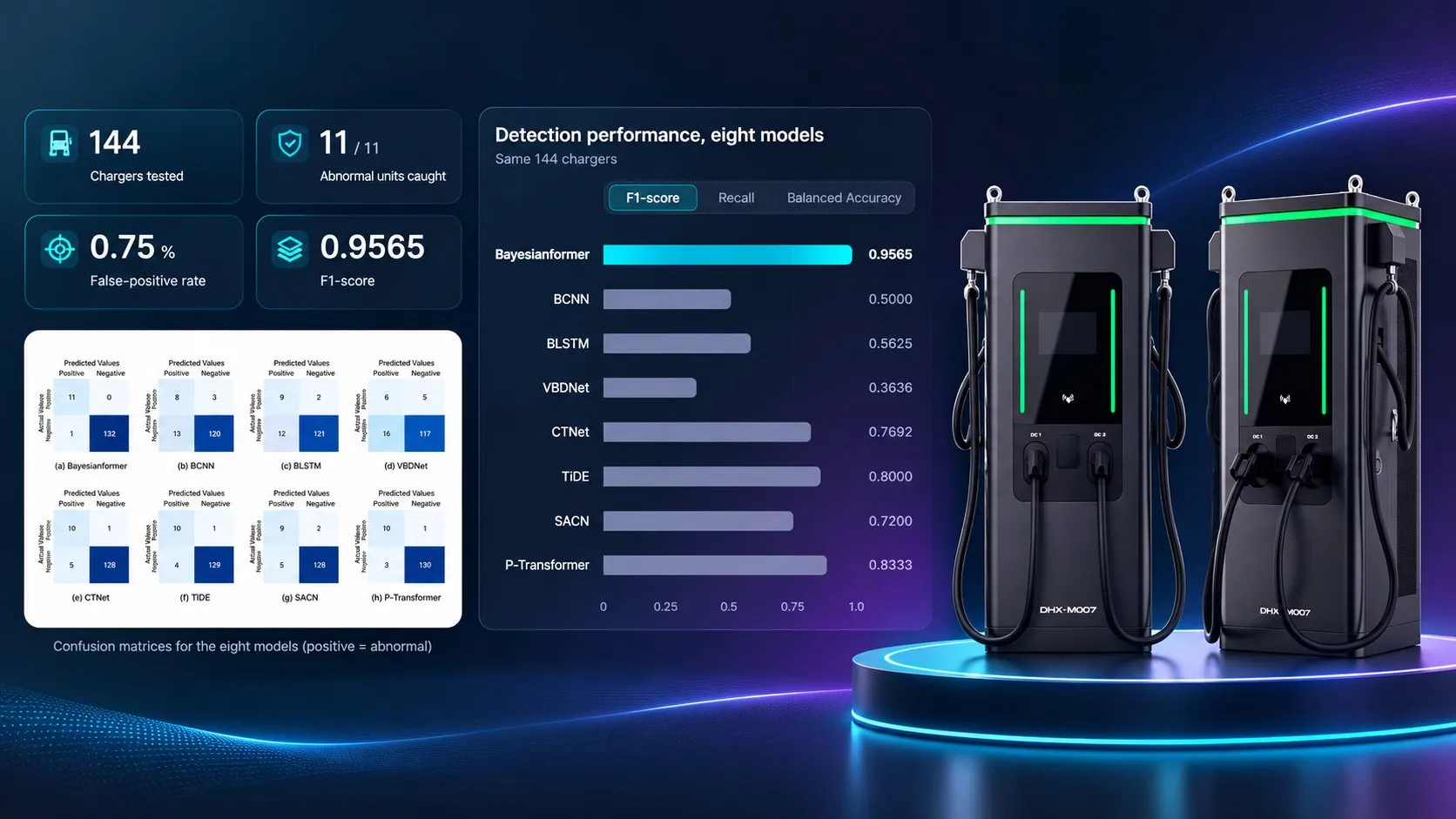
The model was run on 144 chargers of different models in different settings, 11 of them faulty. It found all 11 (100 per cent recall) and raised one false alarm among the 133 healthy units: a false-positive rate of 0.75 per cent and an F1 score of 0.9565. For an inspection team, that means no faulty charger missed and almost no wasted site visits. The lower bound of its ROC-AUC confidence interval, 0.988, is above the upper bound of all seven comparison models.
Fault diagnosis with little data
With vehicle-to-grid, a charger works in both directions, and a failed IGBT in its three-phase bridge affects both metering and safety. Observer-based methods struggle because some states cannot be measured and the signals are noisy; purely data-driven methods struggle because faults look alike and labelled data is scarce. The PFFD network builds the circuit’s own parameters into the model, removes noise at the feature level and combines the result into signatures for compound faults.
On a simulated three-phase full-bridge test platform, raising noise from 5 to 20 per cent only moved PFFD’s accuracy from 83.36 to 81.73 per cent, while the best of six comparison methods fell to 68.94. With training data cut from 1,000 samples to 300, it still reached 80.86 per cent.
Next
The two models are meant to work together in one platform: remote metering flags a charger whose error is drifting, with a confidence attached, and diagnosis says which device is failing, so the site visit that does happen is the right one. The full research case study, with every figure and table, is on the Ingendia demo platform.
Next project
A 45 ft battery storage container for an AI centre